
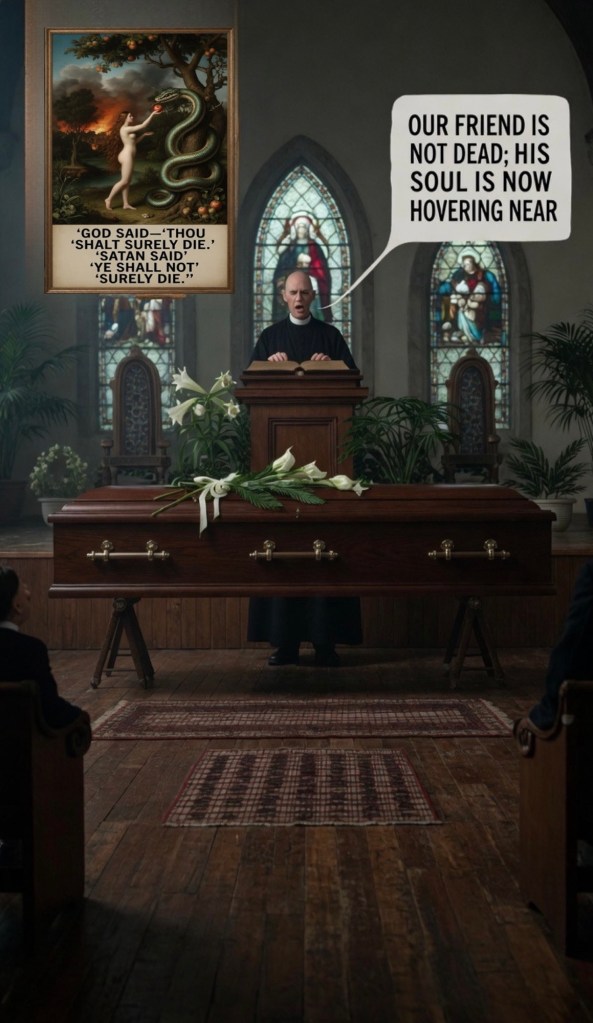
WHERE ARE THE DEAD?
Accepting the recognized fact that the whole world is rapidly going down into death and the estimate that twenty thousand millions of our neighbors and friends have already gone thither, our topic will be recognized by all as a most pertinent one. To be without thought on this subject or to discuss it lightly should be esteemed a mark of insanity, signifying as little reasoning capacity respecting it as that possessed by the brute creation.
Whatever our previous thoughts on the subject have been, we are all inquirers for the truth, and as such endeavoring to have our minds as free as possible from superstition and error. More than this I trust that, living in this blessed land so highly favored of God, and having some acquaintance with His Blessed Book, the Bible, we have learned to appreciate it as a Divine Revelation, able to make us wise in the wisdom which cometh from Above.
We hope, dear friends, that the growing spirit of scepticism has not seriously attacked our faith in this Blessed Book. We are well aware, however, that today the intellectual world, under the lead of so-called Higher Critics, is rushing madly onward into infidelity, into disbelief of the Bible as an inspired revelation from God.
True, this infidelity is not the foul-mouthed kind of Thomas Paine or Robert Ingersoll, but it is all the more forceful in its undermining of Christian faith because its advocates include some of the brightest members of the Christian ministry and nearly all the professors in nearly all the colleges and seminaries of all denominations. I hope that as I shall present to you the true Bible teaching of “Where are the Dead?” you will see that this Blessed Book has been maligned and misrepresented even by its friends, and that rightly understood, reasonably interpreted, it presents the only tolerable view of our subject, the only satisfactory explanation.
“DOCTRINES OF DEMONS”
The Apostle calls our attention to the fact that the heathen in his day labored under the delusion of “doctrines of demons.” (1Ti 4:1.) We know what those doctrines were, for they are still prominent throughout heathendom. Plato, one of the philosophers whose teachings were widely accepted at that time and which were set aside by the Apostle as vain philosophies, the wisdom of men as compared with the wisdom of God, taught the theory of human immortality. (Col 2:8.) He claimed that man received from the gods a spark of Divine quality which could never be extinguished, and that hence his portion must be to live on and on throughout all eternity.
THE VIEWS OF CHRISTENDOM
The dead are in one of three places:
- A very few saintly ones went to Heaven directly at death;
- A comparatively small number who died outside the Roman Catholic faith, in wilful opposition thereto and hence called heretics, have since their death been enduring a hell of torture which will be never ending;
No wonder our dear Catholic friends and neighbors, as they have these pictures before their mental vision as their prospect after death, have not only sad countenances but a terrible fear of death and thereafter.
Neither should any think that these Catholic doctrines of the past have in any degree changed at the present time. In this very day Catholics have tracts for their children which describe in vivid language the most excruciating tortures awaiting those who in any sense or degree are disrespectful or disobedient to the priests and the teachings of the Catholic Church.
It is no wonder, then, that Catholics make no pretensions to a love for God. They fear and dread. The hope held out to these is that any good deeds of theirs will be credited up and serve to shorten the period of their sentence to suffering, the period of their stay in Purgatory, the period of their deliverance to Heaven. This doctrine of life in Purgatory is the basis for the many exhortations from Catholic pulpits and Catholic books that faithfulness be manifested by penances and masses. A certain number of attendances at Church in the Lenten season constitutes a penance to which is attached a blessing and the remission of so many years of purgatorial suffering. Those who have money are exhorted to set apart a good portion of it to defray the expenses of masses for their own soul or for those of others. The calculation seems to be that all the penances and all the masses imaginable would still leave long years or decades or centuries to be suffered before deliverance to Heaven.
And this rule is applied indiscriminately to rich and poor alike, high and low.
To illustrate, when Pope Pius IX died, masses were said for the repose of his soul throughout all the Roman Catholic Churches of the world. Likewise when Pope Leo XIII died, the same command for masses for the repose of his soul went forth, and was executed in all Catholic Churches. This implied the belief that these men, while the highest functionaries of that Church, were not sufficiently holy or pure or good to be admitted to Heaven; for surely those gaining access to Heaven have no need of masses for the repose of their souls. The expression “repose of the soul” implies the tortures of that soul in Purgatory, and supplication and endeavor to have God remit a measure of those sufferings and shorten the period of the tribulations.
We are not making light of those matters. We are merely stating them, not because they are unknown, but because they are not realized and appreciated. All Catholics then, we believe, will assent to our declaration that their faith is that the great mass of mankind are now in Purgatory, a comparatively small number in eternal torment, which they call Hell, and a small number, comparatively, in Heaven. It should be remembered, however, that on a Papal Jubilee it is the custom for the Pope to exercise a power he claims is his, of setting free from Purgatory certain thousands of its inmates who have not fulfilled all of their term of punishment, though it is to be supposed that it is not his intention to admit them to Heaven insufficiently purged.
PROTESTANT CHRISTIAN VIEWS
Protestants claim to be much in advance of Roman Catholics in respect to their religious faith. They often, we know, speak of Roman Catholics as ignorant, superstitious and deluded. What shall we say then if we find that the Protestant view on the question of our discourse is much more unreasonable than that of Catholics? We at least would be obliged to say that they have no room for boasting.
The dead, Heaven or Hell. We inquire of them, Who go to Heaven? They answer, The saintly, the holy, the pure in heart, the Little Flock, the Elect, those who walk in the footsteps of Jesus. We inquire respecting the rest, and hear the Protestants (to their credit be it said) balk at the teaching of their creeds even while they affirm them, and declare that all not begotten again of the Holy Spirit, not sanctified in Christ, not saints, go to hell.
“COME, LET US REASON TOGETHER”
In the Bible the Lord appeals to our reason, saying, “Come, let us reason together.” (Isa 1:18.) He does not intimate that we should reason without Him and without His Word; but He distinctly implies that His Word should be reasoned upon, be considered by our minds.
Still worse; that none of these views seem to be God-like, but that all of them condemn themselves as being devilish.
Reasoning power on religious subjects seems to be a scarce commodity. Many Christian people seem to understand the invitation to reason with God to mean that He wishes them to tell Him just what are their preferences; and that if they remain obdurate, holding to their preferences, He will finally give in and say that their wills shall be done in Heaven and in earth.
He says in our text, “His sepulchre is with us.”
But wait a moment, dear friends; let us not too hastily decide that the Bible is unreasonable in its presentations.
Let us not prove or test it by human theories.
The poet has truly said:
“God is His own interpreter,
And He will make it plain.”
The stake or tortured one another with the rack, the thumbscrew or other devilish inventions. We do not approve the moral character of those men, and we should not expect their doctrinal teachings to be much superior to themselves, nor much in harmony with Divine truth and revelation. Let us then examine hell from the Scriptural standpoint. Let us hear what God has said.
In the English the word occurs thirty-one times, in the Hebrew, sixty-six times. How has this Hebrew word sheol been translated in our English Bible? We answer that the thirty-one times the word hell occurs are from this word sheol, that it occurs twice more in our common version where it is rendered “pit,” and that it occurs thirty-three times more in our common version and is rendered “grave.” Furthermore, in two of the places where it is rendered hell in our common version, it is interpreted by the marginal reading, “Hebrew, the grave.”
The fact, dear friends, is, as every Hebrew scholar knows, that the word sheol is never used to refer to a place of fire or of torture. In every instance, whether used literally or figuratively, it refers to a death state.
Furthermore, as we have already stated, both good and bad are reputed to go thither. David went to Sheol, our Lord Jesus went to Sheol, according to the Scriptures.
“I will be thy destruction.” (Ho 13:14.) Furthermore, we have the Scriptural declaration respecting Sheol that it contains no fire, no suffering. We read, “Whatsoever thy hand findeth to do, do it with thy might; for there is no work, nor device, nor knowledge, nor wisdom, in Sheol, whither thou goest.” ((Ps 88:12.) Realizing this should make us all the more diligent in the present life.
REDEMPTION FROM SHEOL
God has explained the matter expressly enough, but our poor heads were befogged with the doctrines of devils handed down from the Dark Ages, often by very good and well-intentioned people, amongst others our parents.
“Sinners.” (Ro 5:12.) How plain that is! Not a word about eternal torment as the penalty for our sins inherited from Father Adam. Quite to the contrary, it was a death penalty, a just, reasonable penalty. God, who gave the opportunity for life eternal, had the full right, the full power, to terminate that life when used contrary to His Divine injunction.
(Ec 3:20), the Lord graciously informs us that He has found a Redeemer for Adam and his race. The Scriptures point us to Jesus and the work that He accomplished on our behalf. He died, the Just for the unjust, that He might reconcile us to God. ((1Ti 2:6;
HADES TO BE DESTROYED
The equivalent of the Hebrew word sheol, as we have already stated, is the Greek word hades, which is found in the New Testament written in the Greek. In proof of this take our context and note the words of St. Peter that he quoted from “My soul in Sheol,” and in the Greek rendered it, “Thou wilt not leave My soul in Hades.”
This great underworld of the dead, the tomb, Sheol, Hades, has many cities of the dead called cemeteries. But according to the Scriptural symbolization it is a great prison-house. In it are estimated twenty thousand millions who have died. They are called in the Scriptures “prisoners of hope,” because the Lord has promised that ultimately the great prison-house shall be broken up and all these prisoners shall be released, brought back to consciousness again under better conditions than now prevail.
1Pe 3:18.
To the Prophet telling of this coming blessing upon the prisoners. Speaking of Christ and His work during the Millennial Age, he declares that the Lord shall say to the prisoners, “Go forth!” to them that are in darkness, “Show yourselves!” (Isa 49:9.) Their coming forth will be that they may manifest their real sentiments either for righteousness or for unrighteousness, when they will have a full, complete opportunity for choice.
How beautiful the picture! Twenty thousand millions of prisoners, slaves of sin! The great Deliverer has provided their ransom by going into death on their behalf. Because of His faithfulness He was rewarded with life on a still higher plane, and has thus become the Author of salvation to all them that will obey Him.
HELL IN THE REVISED VERSION BIBLE
There is an excuse for the rendering of the words Sheol and Hades by the English word hell. In old English literature we find that the words hell, pit and grave were used interchangeably; and that while grave and pit have maintained their original significance, the word hell has gradually changed, until now by that word is generally understood a place of torment.
In old English a farmer writing to his friend says, “I intend to hell my house this fall, and we have already helled 150 bushels of potatoes.” What does he mean? Simple and plain enough! He means that he is about to thatch his house with straw, covering it over, burying it after the old style almost down to the ground. He means that he has pitted or put away for winter and spring use the potatoes, which will keep better thus than otherwise. So, then, the translators of our Bible are not to be blamed for the indiscriminate translation referred to.
Sense of the word did they refer to a place of torment, but that they do signify the death state. How then did they translate these words Sheol and Hades? We reply that they were too honest to translate them with the word hell, but not honest enough to give the English reader the truth on the subject; and hence they gave no translation at all, but merely introduced the Hebrew word sheol in the Old Testament and the Greek word hades in the New Testament without translating them. The public, thoroughly deluded on the subject, at once declared that their course was one of leniency, and that Sheol and Hades were just as hot as when translated hell. The fact is, dear friends, as we have already stated, that there is no fire connected with either of these words in any proper interpretation of them.
“ALL THAT ARE IN THE GRAVES”
We have set before you the Scriptural presentation on this subject. Where are the dead? It may be disappointing to some of your minds as you think of the saintly ones of your friends and relatives. But they surely have not been very many. On the contrary, the great mass of our friends and those who have died have given no evidence of being spirit-begotten, pure in heart, saintly.
(Joh 11:25; 5:28.) Those of you who are Christians will not doubt the Redeemer knew where are the dead. And in this Scripture which we have just quoted it distinctly says that they are in their graves, not in Purgatory, not in a hell of torment, not in Heaven; they are in the tomb, in the death state, and from the death state He will call them forth in the Resurrection Morning.
What more could we ask than this positive statement?
Who dares to contradict Him, who spake as never man spake? What theologian would have the temerity? Note how complete is the harmony between His statement and that of our text. St. Peter, one of the chiefest Apostles, declares that David was still in his sepulchre, had not ascended into Heaven; Jesus Himself declares, “No man hath ascended into Heaven,” and again, “All who are in their graves shall come forth.” The next verse tells that in the coming forth there shall be two classes, the one perfect in life, glory, honor and immortality; the other still imperfect and to receive chastisements, judgments, disciplines, with a view to their ultimately attaining a full resurrection out of sin-and-death conditions if they will.

