
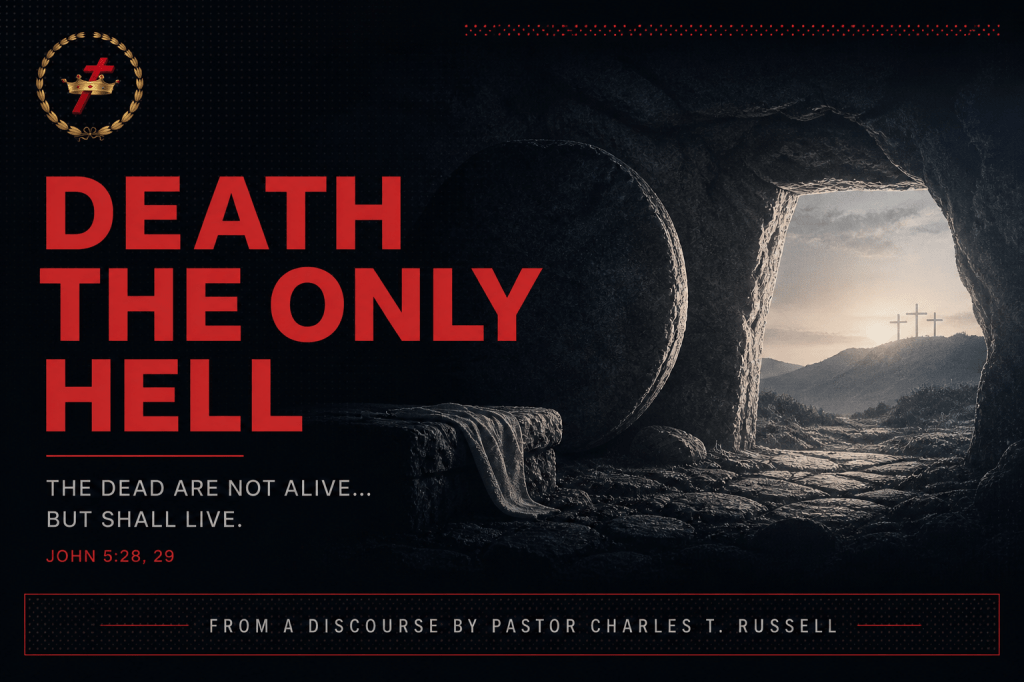
From a contemporary newspaper report of a discourse by Pastor Charles T. Russell, “Beyond the Grave” in 1913.
HELL IS STATE OF DEATH
The hell of the Bible is the tomb, the state of death. The Hebrew word “sheol” and the Greek word “hades” mean the same thing. Any other construction of the Scripture is a misrepresentation of God. We simply are waiting for Christ to gather His church, which is to be His bride, when the 1,000 years of peace will prevail throughout the world.
When the restitution of man comes, the elect of Christ will bless those who have led sinful lives while in the previous life, and all men may be blessed. I do not claim that all will be saved, but those who will not accept Christ in the second life will die and remain in a state of death, which is hell.
GRAVE DIVIDING LINE
The grave marks the dividing line between the known and the unknown. All beyond the grave is held by faith, not by knowledge. How important then that we accept only divine testimony on a subject regarding which none but the Almighty could enlighten us. We admit that our own guessing on this subject would be unsatisfactory. Why, then, prefer the guesses of other men who know no more on the subject than we do?
I know that spiritism claims to have communications from the dead and that thus it has proofs. I admit that some learned men have become psychists and corroborate spirits. I prefer, however, to follow the Bible’s teachings and to believe those men are deceived. The Bible tells us that the intelligences which communicate through the mediums are not dead humans, but the fallen angels. The Bible tells us that these evil spirits, “demons,” purposely strive to deceive humanity, and to misrepresent God’s plans; and that God will not fully restrain them until an appointed time, but permits them to test our loyalty and faith Godward.
BIBLE LOGICAL
When I say that the Bible’s teaching regarding “beyond the grave” is logical, some will scoff. But hear me for my cause. Hear the Bible’s own testimony—not what the creeds say it teaches.
It teaches that the dead are not alive anywhere—that a dead person cannot experience either joy or sorrow. It teaches that all hope of a future life by divine appointment is vested in Jesus, who died that we might as a race be released from the death sentence inherited from Father Adam, and that thus Jesus might become the life-giver or Savior to as many as will return to God through Him.
The promise of the Bible is not that the dead are not dead, but that “thy dead men shall live.” Because of the proposed resurrection of the dead they are figuratively said to “sleep.” Thus the hope set before us is: “Many that sleep in the dust of the earth shall awake, they that have done good (that passed divine approval, the saintly) shall come forth to shine as the stars of heaven.” They that have not been approved shall awake to shame and lasting contempt. Their shame will last until they reform—their contempt until they shall cease to be contemptible, and learn and obey the way of God under Messiah’s Kingdom.
REDEMPTION NECESSARY
Death with its attendant mental, physical and moral weaknesses, is God’s curse or penalty for Adam’s sin of disobedience. Resurrection, uplifting from all this, is God’s remedy—the lifting of the curse. The Redeemer’s death was necessary as man’s redemption price. Next in order will be His Messianic Kingdom. He must reign 1,000 years to fully overthrow the power of sin and death and to uplift or resurrect the willing and the obedient, thousands of millions of Adam’s family for whom he died—“every man.”
The perfect man, Adam, and his perfect, happy, Eden home were a picture, a prophecy of what all may attain, if they will, through the Redeemer’s Kingdom. What a glorious outlook “beyond the grave” we find in the Bible, for the world! Those refusing to progress, the Bible declares, will be cut off from life in the second death. It will be like the first or Adamic death except that there will be no redemption from it—no resurrection from it. All consigned to it will, St. Peter declares, perish “like natural brute beasts” in everlasting destruction,” St. Paul declares.
Note the beautifully sympathetic description of God’s work for men through Messiah’s Kingdom: “God shall wipe away all tears from all faces; and there shall be no more death, neither sorrow nor crying, neither shall there be any more pain there.” (Rev. 21:4; Isa. 25:8.)
The explanation is: He that sitteth upon the throne saith, behold, I make all things new (Rev. 21:5). A new heaven of spiritual power will have supervision of earth’s affairs, and a new earth or social order will obtain amongst men. These are the glad “times of restitution” which St. Peter tells us will begin at the second advent of Jesus’ (Acts 3:19-21).
THE MESSIAH’S KINGDOM
All except those now spirit-begotten will share in the general resurrection or uplifting of Messiah’s Kingdom during his reign of 1,000 years. Some are more and some less dead, morally, mentally and physically, than others. Hence some will need more and some less uplifting or resurrection. But all need it greatly. Without Messiah’s aid they could never get free from the death and into perfection of earthly life. It will require all of the 1,000 years to uplift or resurrect the world. Hence only the church class, changed to heavenly nature, will really live again fully until the thousand years shall be finished, although the willing of the world will be gradually rising, gradually experiencing restitution or resurrection, throughout that thousand years.
If “beyond the grave” means Paradise Restored, and human perfection to mankind in general, it means still more to the saintly Church of Christ—his bride. Let us all live godly, but let as many as will become footstep followers of Jesus and thus gain with him glory, honor and immortality.


Leave a Reply