Matt. 6:5-15
“Pray to thy Father which is in secret.”
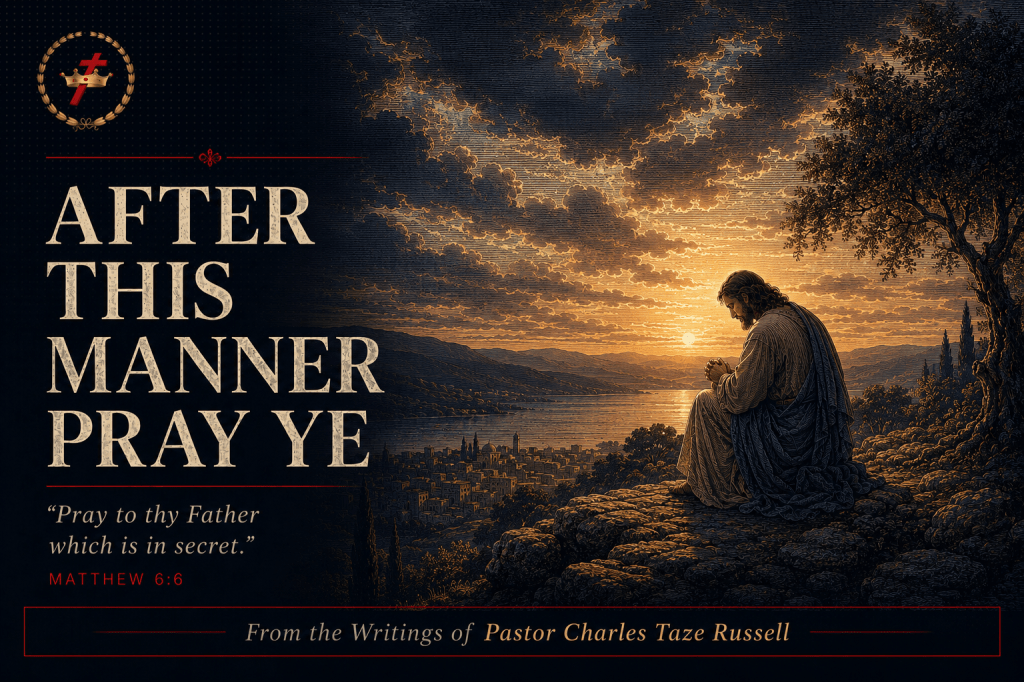
“PRAYER is the soul’s sincere desire, uttered or unexpressed,” says the poet: and he says truly, for the Scriptures inform us that God is a “discerner of the thoughts and intents of the heart;” and again, that in the case of the saints the spirit or intention is accepted by the Lord when we approach him in seasons of distress, when we can find no language in which to clothe our feelings and desires, when we come to him with spirit-groanings which we cannot utter in words. (Rom. 8:26.)
Nevertheless both by words and example our Lord instructed us that our prayers should be uttered, formulated, and, if possible, not be left merely to incoherent feelings and groanings. It was to this end that he gave the instructions of the present lesson, in answer to the request of the apostles, “Lord, teach us to pray.” (Luke 11:1.)
While certain rules should govern all prayers, all approaches to God for communion, namely, that we should approach with humility and simplicity and reverence and in the name of Jesus, yet circumstances may govern in certain particulars:
(1)
The prayer of the sinner, the alien and stranger from God, should differ from that of the child of God who has received pardon and reconciliation along the divinely appointed lines.
For instance, the prayer of the publican, approved by our Lord, did not address Jehovah as “Father” but as God, “God be merciful to me a sinner.” On the contrary, those who come into relationship with God under the terms of his covenant in Christ have the privilege not only of recognizing God as the Creator and Ruler, but also as their “Heavenly Father,” and of addressing him as such.
(2)
Amongst those who approach God in prayer as his children, different circumstances and conditions may have a bearing as respects the manner of worship: at times they may properly go aside and hold communion with the Father in secret, where no earthly eye will see and no earthly ear will hear.
Our Lord’s own example should be an illustration of this privilege: we remember how it is written of him frequently that he went apart from his disciples and prayed alone, and how sometimes he spent the entire night in solitary prayer.
(3)
Prayer at other times may properly and profitably be offered in the presence of fellow-believers and audibly, as the prayer of all and in which all are interested and join.
This is implied in the account given in Acts 1:14 where it is declared, “These all continued with one accord in prayer and supplication, with the women, and Mary the mother of Jesus, and with his brethren.”
Again in 1 Cor. 14:16 the Apostle shows the thanksgiving of the congregation was and should be presented before the Lord not only audibly but in a language heard and understood by the worshipers, so that all might be able to say “Amen” to the thanksgiving and petition.
(4)
At times it may not be improper to give thanks to God in the presence of a mixed company, believers and unbelievers.
Again our Lord prayed in public, in the hearing of the mixed gathering, at the grave of Lazarus.
Again our Lord’s last prayer, on the cross, was audibly heard even by his enemies. (Matt. 27:46,50.)
We have gone into details of proof respecting this subject because some of God’s dear people have fallen into the error of supposing from this very lesson which we are about to consider, that it is wrong, sinful, to pray with or in the presence of others, either the Church or the world; they evidently put more stress upon our Lord’s words, “Enter into thy closet, etc.,” than our Lord intended.
We remark incidentally, however, that we have no sympathy whatever with a practice which seems to be very common with the majority of Christians, namely, that of preaching at transgressors and scoring them, in prayers ostensibly offered to God.
There are indeed strong reasons for believing that many of the prayers offered are offered more to the congregations who hear than to the Almighty.
The customs of Christendom differ; and yet in every direction we may find evidence of the same spirit, ambition to be thought pious, effort to make an impression upon men and women, rather than to hold communion with the Heavenly Father.
Such hypocrisies cannot be too strongly guarded against in all those who seek and enjoy communion with the Father and with our Lord Jesus Christ.
TO WHOM SHALL WE PRAY?
Our Lord’s instruction is, “Pray to thy Father,” “Pray, our Father which art in heaven.”
But this instruction is to be coupled with the further instruction, “Whatsoever ye shall ask of the Father in my name he will give it you.” (John 15:16; 16:23.)
“No man cometh unto the Father but by me.” (John 14:6.)
Only believers who have accepted Christ may approach God in prayer and call him “Father.”
“Use not vain repetitions as the heathen do.”
The Lord wished his followers to pray intelligently and realize that they were approaching an intelligent and reasonable God who knows already, far better than we, what things we have need of; and who is more willing to give them to us than earthly parents are to give good gifts to their children.
The Christian neither needs to repeat certain prayers indefinitely, nor does he need to take up in prayer all the affairs of the world and the affairs of the Church, to tell God all about them and how they ought to be regulated.
No man is in a fit condition of heart to approach God in prayer who has not first learned of his own ignorance and lack of wisdom, and learned also of the Lord’s infinitely superior knowledge and wisdom and power and love.
“Your Father knoweth what things ye have need of before ye ask him.”
Our prayers therefore are not to induce God to give us things which he desires to withhold from us, but are merely to secure the things which he desires us to have and has promised to us, and is more willing to give than to withhold.
“AFTER THIS MANNER PRAY YE.”
“Our Father which art in Heaven, hallowed be thy name.”
This portion of the petition is an address of reverence, an acknowledgment of God’s greatness, and implies our humility and littleness.
It implies that the worshiper reverences God and is not undertaking to address him in a light or irreverent manner: even his very name is revered as holy by the true worshiper.
“Thy Kingdom come: thy will be done in earth as it is in heaven.”
It is an acknowledgment that the worshiper not only believes God’s promise but that he is in sympathy with it and desires the Lord’s Kingdom, longs for it.
It thus implies that he is not in sympathy with sin, nor with the kingdoms of this world and the present order and its imperfect social, financial, political and ecclesiastical arrangements.
It is an acknowledgment, furthermore, that the worshiper is longing for the condition in which no sin will be possible, in which God’s will shall prevail on earth as well as in heaven.
“Give us this day our daily bread.”
It is not an appeal to God for superabundance and much goods laid up for many days; nor is it a request for luxuries: but merely asking, Lord, give us those things which are needful to us daily.
Contentment is the very spirit of this petition.
“And forgive us our debts, as we forgive our debtors.”
The very essence of Christian principle is love, sympathy, forgiveness of the faults of others, even as we realize we have faults ourselves and that God has graciously forgiven us these for Christ’s sake.
Let every Christian in approaching the throne of the heavenly grace, daily inquire of his own heart, whether or not he has forgiven those who are indebted to him, as he desires that God should freely forgive him for Christ’s sake.
“And lead us not into temptation, but deliver us from evil.”
It is a part of the divine arrangement to bring us or permit us to be put into positions of trial or testing.
We are not to rebel against the divine wisdom in this matter, but quite to the contrary to acquiesce in it, and to realize that trials are essential to our development.
Hence, instead of praying to be kept from temptations, our prayer rather is that when our Lord in his providences brings us into places of testing, he will also stay with us during the trial, and let his grace be sufficient for us.
Abridged from the original January 15, 1898 Watch Tower article by Charles Taze Russell.


Leave a Reply