
The Last Words Of Pastor Russell
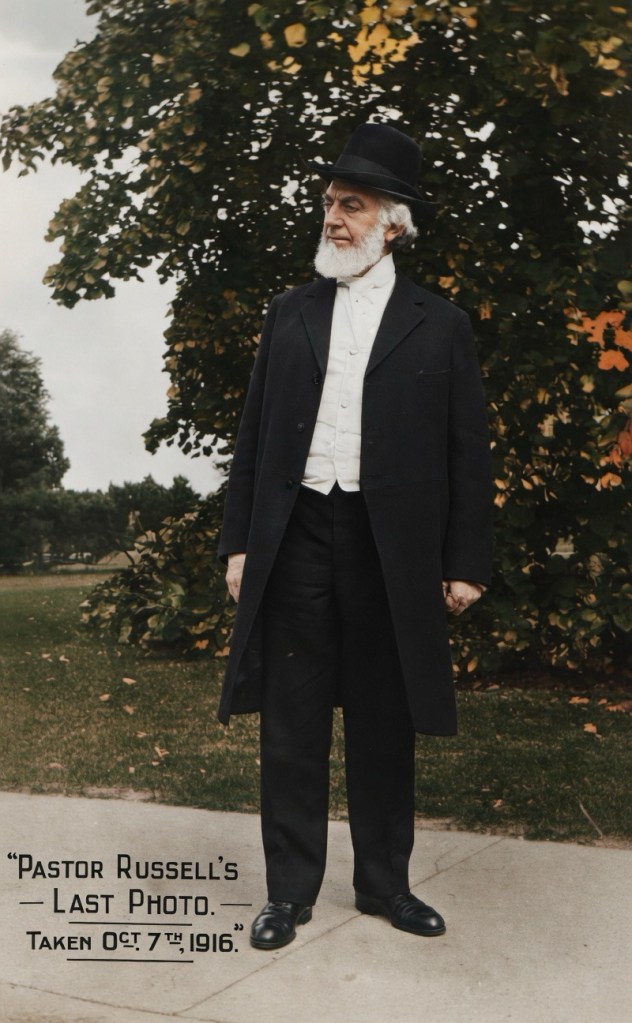
Wise Words of Our Dear Brother as He Seeks to Aid the Brethren in a Business Matter, Seasoned with the “Salt.”
UNITY OF LOVE INSURES FELLOWSHIP AMONGST BRETHREN
Brother Russell’s Pastoral Words of Counsel, Showing How the Conscience Is to Be Guided By the Divine Mind to Keep From Shipwrecking the Soul.
SIMPLE OPEN-HANDED DEALINGS ALWAYS.
A REMARKABLE example of laying down the life on behalf of the brethren was always manifested by that dear saint of God, Brother Russell. But, especially, can we realize it when we come to know Brother Russell’s physical condition and that for weeks prior to this meeting in Los Angeles our brother was dying by inches. Yet, not once did he cease to serve the brethren, and in this instance he was so weak he was forced to sit while speaking.
After counseling in a business matter, in which it seems apparent the Disciple Congregation at Los Angeles, with Brother Scott Anderson as pastor, was about to come over en masse to the I. B. S. A., his thoughts like the needle to the pole flew to the brethren, in these words: “Are there any questions?”
Regarding this Los Angeles meeting the Watch Tower (Z. ’16-364) says:
On to Los Angeles.
Our train was an hour or more late in arriving in Los Angeles on Sunday morning, Oct. 29, and we had had nothing to eat. The brethren were rejoiced to see us, but their countenances changed when they saw our dear Brother Russell. They saw that he was weak, but they knew not how sick he was. Besides, he would not yet admit that he was really sick. By 10 o’clock we had reached the hotel, and I asked him if I could not get him something to eat. He said he was not hungry and asked me to suggest something. This I did. He consented to my getting something, but only tasted a little of it. Upon bringing it to him, he asked if I had had my breakfast; and when I answered, no, he wanted to know why. I told him that it was because I wanted him to have his first. He said he would not eat his until I had first had my breakfast.
This was just like Brother Russell. He was always so considerate of others. Whenever he would ask me to do anything for him, he would say, “Please”; and when it was done he would invariably say, “Thank you.” He was a wonder! Brother Homer Lee did what he could for Brother Russell while we were there and, upon our departure, gave me his best remedies, and hoped they would do him good. The brethren in Los Angeles were kind in every way.
Brother Russell’s Last Address to the Church.
When the time came for the meeting with the friends in the afternoon, Brother Russell arose and made ready to go, the brethren having come for him in their auto. It was 4:30 Sunday afternoon when we left the hotel for the meeting, which was held in the same auditorium in which the Los Angeles Convention was held during the first part of September. It is a quiet and suitable hall. We do not know of any better or more appropriate place in which Brother Russell could have given his last message to the Church. He cautioned the brethren against exposing his physical condition by saying, “Don’t give me away, Brethren.”
You know that our dear Brother was so considerate of the feelings of others that he never drew much on the sympathy of the friends, so considerate was he, that but few knew that he had been a physical sufferer for 30 years. On one occasion recently he sent word to the Bethel Family that he would not be down to breakfast; and afterwards he told me that it was on account of the family that he did not come, that they had such deep sympathy for him that he did not like to draw on their vitality. He had learned to lean on the Strong Arm alone! He did not need us particularly, but we needed him.
We were on the alert to comply with his every wish; and therefore no one called attention to his condition, and in that sense did not “give him away.” However, he gave himself away. To a keen observer his very presence spoke volumes. But more than that, when he stepped to the front of the platform to begin to speak, out of consideration for the splendid audience before him (for every seat was occupied) he said, “I regret that I am not able to speak with force or power,” and then beckoned to the Chairman to remove the stand and bring a chair. As he sat down, he said, “Pardon me for sitting down, please.” In deep humility, in great suffering and in the most solemn manner, he spoke for about 45 minutes, and then answered questions for a short period.
(Sunday, Oct. 29, 1916; 5:00 p. m.)
I regret that I will not be able to speak with force or power. Pardon me for sitting down, please. Indirectly, dear friends, I have heard that you had certain movements on foot in respect to a new meeting place in connection with a company of people formerly known as the Christian denomination. It has been intimated to me that I could not speak on any subject of more interest to you than that one.
I might say at the beginning that I have not discussed the matter with anybody. I have a letter from our brother of the Christian denomination, but not answered. Think now the best way, therefore, would be to rehearse the matter as I understand it. I think I have a clear understanding of it in that there seems to be nothing very abstruse or difficult about it. From what I have learned some of the friends felt quite perturbed. I see no reason for having any distress on the subject, and my reason is this: as I have already pointed out to you in the Studies in the Scriptures, especially in Vol. 6, there is an approved order in the Church of God, and if that order be lived up to there will surely be nothing more effective than it is, but if refracted at all, if neglected at all, then, like a delicate piece of machinery, it will go to pieces very readily.
In all my experience everywhere I have found that where there are truly the Lord’s people they have entered into the Lord’s family upon certain terms and conditions, and, in order to remain in the family they must abide by those terms and conditions. The terms and conditions upon which we come into the family of God, in Brooklyn and everywhere, are that we make a full surrender of our hearts to the Lord, a very sweeping statement in a few words. A full surrender means a great deal. It means our will, our talents, and everything we possess. Not to each other, but to the Lord, with the idea that if we will follow this course, He will direct our path, as the Scriptures declare. My position therefore is that all the Los Angeles class as well as all of every class of God’s people, are as desirous today as when they entered the Lord’s family of knowing His will and doing His will. In fact, if you could maintain shades of differences it would mean that we should be all the more advanced as Christians, our wills all the more buried, and, as the Apostle even intimates, there might be a disposition on the part of the old will to be raised up again, so that we need to be on guard constantly; consequently he says, I remind you, when speaking of himself, “I keep my body under lest after having preached to others I myself should be a castaway.” Showing very clearly, my dear brethren, that to get into the family of God is not enough, but it is essential that we abide in Him, and the Scriptures very particularly tell us that we abide in the Lord by doing His commandments, not the ten commandments, of course, but the essence of these commandments would be included, especially the new commandment that Jesus gives us, that we love one another. In other words, that this perfect bond of unity, of love, in all must continually be more and more the mind and disposition of all those who abide in God’s love. I believe there will be no dissenting voice to what I have said. I think you will all recognize that the principle is so broad and so scriptural that there will be no dispute whatever.
Perfect Will Operates in Imperfect Body.
And yet, God’s people do have disputes, and they often arise from our having imperfect heads. All having perfect wills, the question is, How shall this new, perfect will thoroughly direct the imperfect mind, imperfect body?
If we have the principles involved before our minds, then, dear friends, we are prepared to come a little closer to the facts that seem to trouble us occasionally. The Bible does indicate that there will be a certain time when we shall find it necessary to stand for principle from which we should never depart. The principle relates to the individual conscience. Whoever will violate his conscience will surely do injury to himself, no matter how well-intentioned he may be.
Of these matters to which there may be conscientious difficulty, or objections, or principles involved, the first one should be DOCTRINAL. The faith once delivered to the saints is to be put way ahead of your opinion, my opinion, everybody’s opinion. The faith once delivered to the saints is the important thing. It is the great gift from God; without it we would be without any plan, or purpose or arrangement. There could be no Divine Plan of the Ages at all without this quality. On the other hand we should remember that sometimes our minds might become more or less warped or twisted, so that we will imagine things to be conscientious difficulties when they might not be such at all. We are therefore, to be on guard against making a mistake of that kind.
In the case under consideration something might, of course, be said on different sides of the question. I will merely offer a few suggestions. As, for instance, would it be wise or proper for Bible Students to meet with those who profess a different thought, such as the Disciple friends hold? I would not think it would be right to compromise any doctrinal question, no matter what the considerations were. Now, on the other hand we learn that this is out of the way, that our friends of the Christian Church mentioned have seen a great light, the Lord has greatly blessed them; that our brother, the pastor of the church, has seen clearly the truth of God’s plan, the Divine Plan of the Ages, and that therefore there would be no doctrinal differences between us. Our Disciple friends claim to have no doctrinal differences, and yet we know that, as a denomination, they do have some very strong differences, the reverse of what we hold on many subjects. The question then would be, is this a question on which there would be no room to doubt that the minister and the membership of that church had fully determined on their course? He will know this better than I. So far as I can discern from what I have heard, it would lead me to think that the brother, the pastor of the congregation, would be a very suitable brother, a very proper person to be recognized as a brother on the broad plane of all true believers in Christ, but also doctrinally as one who sees very clearly, eye to eye with us. Seeing eye to eye does not necessarily mean that we should see every point exactly alike, but that there would be no material difference. I presume that very few people indeed, especially those that have not been in the Truth more than a year, could be said to see eye to eye on every point of doctrine. It would be remarkable if they could. The Bible intimates that they are to grow in grace and in knowledge, and we realize that this has been the case with ourselves.
Lord’s People Not Coercers.
This dear brother, the pastor of the congregation referred to, so far as I can see, has manifested a beautiful spirit, one of loyalty to God and the Truth, a desire to be in full accord with the Truth, and to cooperate with Bible Students as far as he might be able. I could see no reason why the brother should not come into this congregation and be fully accepted, and so far as my knowledge is concerned, I know of no reason why he should not be an elder in the Los Angeles ecclesia. I can think of none. You may know better. You are the persons in close contact. I would have you remember, dear friends and brethren, that I am not at all attempting to give any rules or regulations. I believe I have no right to do so. I always try to keep within the lines the Lord’s Word lays down until I feel very sure that I am on the right side. This applies to everyone. No one is to dictate. There are no dictators in God’s family except the Lord Himself. He has already dictated what would be pleasing to Him, and that settles it with the Lord’s people today and every day. That is not a thing to be called in question from one time to another. It is a fixed principle laid down. Whoever is not conformed to that order is in contrariety to the rules and regulations of the Lord’s house. If then, Bro. Anderson, in your judgment, be fully qualified for Eldership amongst Bible Students, I think that would settle a great deal, but not all.
The next question would be, would the location of this meeting place that is proposed to be turned over to the I. B. S. A. be a suitable one, would it be convenient, would it be better than what you have? While it is very kind of them to offer it, yet I am not well enough informed to know whether it would be an advantageous move or not. I am merely suggesting to you that this is a point to think about. Would it be advantageous for this congregation to meet in that locality?
Amongst other questions to be considered would be, how much car fare would be necessary to and fro from the various homes? Whether or not it is central? Whether or not it would take too much time in going and coming? I cannot say because I am not familiar with Los Angeles, and my judgment would be therefore worth nothing. I am giving it to you for what it is worth, nothing. These are merely questions for you to think about. It would not do if you were offered a place for your use, even if you were offered it free, it would not do, in my judgment, to go to such a place if it were not conveniently located. No, I think, the convenience of the place both for public as well as for the congregation are matters which should be considered, carefully considered. Not a mere question of a trifle, but an important matter. The Church itself is to have primary consideration in this matter. Would it be convenient for the Church? If so, then would it be convenient for the public? If so, that objection would be altogether out of the way and not worthy of further consideration.
Law of Love a Prerequisite.
Then, another question arising would be, are we sure to what extent this congregation is moving with a free will in the matter? I think that the high standard of the Golden Rule, and in addition to the Golden Rule, the Law of Love, these should be considered by all Bible Students, all consecrated people. If they are willing to give us this property under more or less misunderstanding, then I would think it to be a mistake to take the property under the circumstances. But if all that congregation were willing and glad to be identified with the I. B. S. A. and the Los Angeles Class, if they so voted and wished to be considered as members of the I. B. S. A. and if, first of all, it was clearly explained to them the difference between their ideas and our ideas about Church Government and everything else, I think that would be the only fair and just way to deal with the matter. We would not like for anyone to come into our meeting and to take an advantage of us by voting or by any kind of deceit. I am throwing out these suggestions, dear friends, in a broad general way, because I am ignorant of the situation, but merely giving you in what would be considered court terms, judicious views, that is, a just view respecting the matter.
Now, so far as I can see, dear brethren and sisters, I have covered the whole matter. I have not offered any prejudiced statement from one side or the other, have no reason to do so, but would like that the will of God be expressed to the Church in what they propose doing. Do not allow any thought of having any property worth a few thousand dollars, do not allow that to swerve your judgment in any of these questions. Do not allow it to swerve your conscience! I would think, then, that if I were permitted to direct the voting, the vote first of all would be, Is the location of this meeting house a suitable one, a desirable one? because, if not, that would settle everything. And then, secondly would come in the question, Are these people of this Christian denomination sufficiently instructed? Do they understand that an elder is an elder, that he is not appointed for life, he is not appointed for anything but a period of time? He is appointed by the congregation. There is no denominational appointment connected with it. Do they understand that the title to the property would be in such a form that no individual would have any claim upon it? With that all well understood and the right conclusion be had, then that would be out of the way.
I believe it would simmer itself down to two points. First, whether or not the location is suitable. And secondly, whether or not the congregation now owning the property fully understand what they are doing, and fully agree to what they are doing so that no one would have any chance at any time to say that the congregation had been defrauded, or any unfair means has been used. Everything should be done in a fair, open-handed way, and should be expressed in writing in very plain terms, so plain that anybody could understand. An attorney might draw up a paper that he and other attorneys could understand, but which would do very little toward enlightening the people. My thought would be that this paper should be very plain and simple, stating everything that has been done, the whys and wherefores, and then that these should be printed and before anything be done, that the congregation of this Disciple Church should vote upon it just as it is printed, so that if a question ever came up the printed paper could be referred to and the matter set right. The matter should be made so plain that no one could be defrauded, and everything be done so as to glorify the Lord and serve the best interests of His people.
Now, dear friends, I do not know that I can add anything further. If any of you would like to ask any questions, I would be pleased to entertain them and do my best to answer them. Are there any questions?
“Are There Any Questions?”
Q. Would there be any arrangement to support the brother and his family who gives his entire time to the congregation? Does the I. B. S. A. allow that?
A. A very good question. I remind you all that our preference has always been to have no paid ministry. I would be very sorry to know that that principle would be broken down. I believe that it has had a good influence and that any deviation from it, any setting of it aside, might do a great deal of harm. At the same time, we are not to forget that the Apostle said something to this effect: “A laborer is worthy of his hire,” and applied it evidently in this way, although we should remember that they had no such paid ministry as we have today. The thought of the Apostle seems to have been merely that, every person laboring in the ministry of the Truth as servants of God should be supported in some way, every person giving his time, as for instance, the Apostles themselves gave all their time to those who would hear, but these Apostles were exceptions to the rule, doing an Apostolic work in the sense that is not generally paralleled in our day.
I think the point is well taken that we should consider that. I do not know what Bro. Anderson’s view on the subject would be. Neither do I know what his talents are with respect to other employment. St. Paul (using the illustration of his own case) labored with his hands that the Word of God be not charged. We have found a great blessing in following this course in Brooklyn, everywhere. There are a great many ministers today who are serving the Truth with faithfulness along these lines. I am merely saying that there is no commitment that the ministers might not receive a fixed stipend or wage. For my own part; I would very much prefer to receive nothing directly or indirectly from a congregation. Perhaps this is the most serious feature of the whole matter, but not having any information as to what Bro. Anderson would do, or think of doing, I could not say; but, if there were a consideration, that the congregation should shoulder a salary and in turn have the use of a meeting house, I would think that the principle would be unfavorable, as setting an unfavorable precedent to others, and generally not being in line with what we believe to be the highest standard of the Lord’s Word.
Troubled Waters Quieted, With Love
Another word, dear friends, before any more questions, and that is we are not to allow anything to disrupt the influence of the Spirit in the bonds of peace. Love is the principle thing. Love is of God. He that loveth is begotten of God, and he that is thus begotten will love the brethren. We should always have this basic principle before our minds. Not that it has anything to do directly with this question except that it would help us to decide that nothing should be done through strife or vainglory, but on the contrary, that we should humbly and lovingly desire the interests of the Lord’s cause, have a loving desire for the family of God, for the Los Angeles Class, etc. Nothing should enter our minds in the way of having a will of our own, nor anything be permitted that would tend to break the unity of the Spirit. That should be settled. Then the main question should be voted on by the congregation, and the vote should be accepted as the mind of the Lord. And I think in such a matter as this, as in every matter of the kind, that such a vote should be taken after much prayer, thoughtfulness, the earnest and loving desire for the Lord’s blessing and to know and do His will.
Now, any other questions? (Pause) Have you any other question, dear friends? Do not be afraid.
Q. In writing up the terms of agreement would it be proper to state as one of the terms that the Church at South Park should have the privilege and opportunity of observing the Lord’s Supper as they do now? Some observe it every Sunday, while others would prefer to observe it as we do.
Can We Think as Deep on This?
A. I think we need to find no fault with any of the Lord’s people for observing the Lord’s Supper as they choose. If I were in such a meeting when the wine was passed I would feel it right to participate with them, but it would be in the way of concession, to recognize them as brethren, and not that I thought it was observed in the right way. I would think that if the Disciple friends still held that view, that they remain as they are and study the matter. I do not think that any one who properly considers the matter would have any difficulty with respect to the appropriate time for the commemoration of the Lord’s death. It seems so plain and Scriptural in every way that I cannot imagine anyone having a difference or an objection to it. I have never found anyone who could show that the celebration of the Lord’s death every Sunday would be advantageous. I have never found that person.
The same general remark would also apply to the question of Baptism. I would say that, if our Disciple friends still practice baptism as the Disciples usually do, it would be a great mistake, very undesirable, and injurious in every way. These are things that you know about and that I wish to know about. Anyone who does not understand real baptism does not understand real consecration, and we have reason to wonder whether such an one has ever passed the door of full justification by imputation of Christ’s righteousness. He may be tentatively justified, he may be a well-meaning person, but he has not seen the beautiful arrangements of God’s plan. With those two points, or either of them clearly determined, to my mind it would settle the whole matter and decide my view, and my thought would be that the dear friends be given to understand that, in any event, we have nothing unkind toward them, everything the very reverse, but we thought it best for them as well as for ourselves that they should first tarry awhile, studying and learning more about God’s glorious plan, the door into the Church, etc. Baptism as the door into the Church is very clear to us; not, however, in the way that our Baptist friends view the matter, by no means, but in the way of seeing that the real baptism is the baptism into Christ’s death and the water immersion is merely a symbol of the real immersion into the Divine will.
(Dear Bro. Russell here went out from the meeting for the second time.)
Now, dear brethren and sisters, how best can we help Bro. Anderson’s people to take this view, is the question. Can it be by attending their meetings, co-operating with them in various ways, etc.? I think that the best way is the one that has proven to be the best way for everyone, that is, careful and prayerful study. Nothing else really brings anyone into the Truth. By simply hearing lectures or sermons they only get a mere glimmering of the subject. They should take up the matter and, as the Apostle says, “Study to show thyself approved unto God, a workman that needeth not to be ashamed, rightly dividing the Word of Truth.” I do not think there is any patent, or any other way, for a congregation or for anyone else, to get the Truth. My advice would be to offer, sell or loan to each member of that congregation, a set of the Studies in the Scriptures, and endeavor to get them to read for themselves. I do not know of any way by which you could be any more helpful than by this one.
Berean Study Anywhere If Invited.
Q. If they should invite us to hold a Berean Study in their church, would it be proper for us to appoint a brother to lead that class?
A. In my judgment, yes, in every case. My thought is to never let an opportunity for doing good to pass unheeded. As an illustration. Following Mr. Sunday’s meeting in Philadelphia various Bible classes were started before he left. Some of our friends thought they might do a good work by going here and there in attending some of these classes, thinking that probably the friends in these various classes would probably know very little about the Bible and how to study it, and they might, therefore, be of some help to them in the direction of their desires. The result was that, in one class, I think five came into the Truth. It started in this way: Mr. Sunday had suggested that the Second Coming of Christ would be a very important subject to study. He has a sermon on this subject at the end of every protracted meeting. The class referred to decided, therefore, to study the subject of the Second Coming of Christ, and a minister was appointed to lead the class in this study. To their surprise the minister said that he knew very little about the Second Coming of Christ, and in fact, took very little stock in the subject. The fact that a minister should know so little about and have no interest in such an important doctrine, opened the minds of some in the class. One of the friends who was present at the meeting led off in questions and answered in a very kindly way, not seeking to intrude or in any way to run contrary, to their wishes, but in a kindly and proper way (it was a sister, too,) she got the idea that she might help them some. They were so astonished to find how much she knew about the subject and how little the minister knew that they spoke to her about it, whereupon she remarked that she could bring a gentleman who would be a very fine teacher of that class. They said, very well, bring him right along, with the result that he became the leader of the class for quite a while (it was our dear Bro. Work of Philadelphia), and I think it was five that came out into the Truth. The point is, that in every way we can serve the Lord and His people, whether in a Methodist church, a Disciple church, or where not, whoever it may be if he can get them to study the Bible, they will soon get to see, after they have once been awakened up.
Final Song, and “Goodby.”
Finally he said, “I must say goodbye to you all, and give you a text for your remembrance” — Numbers 6:24-26: The Lord bless thee and keep thee: the Lord make His face to shine upon thee, and be gracious unto thee; the Lord lift up His countenance upon thee, and give thee peace. May the Lord’s blessing be with you richly; He has blessed the Los Angeles Class a great deal. Each one should desire to do his own share. No matter what others may do, each one do his share. Now sing Number One:
“Abide, sweet Spirit, Heavenly Dove,
With light and comfort from Above;
Be Thou our guardian, Thou our Guide,
O’er every thought and step preside.”
Preserve This Spirit in Your Midst.
(Continuing From Watch Tower.)
Continuing, he said, “Isn’t this a beautiful thought? Preserve this spirit in your midst. Have perfect confidence in the Lord, and you will be led aright. We were not brought into the Truth by any human catchword, but by the Word of the Lord. We know that the Lord will bring out everything all right. I bid you all goodbye.” Thus, at 6:05 p. m. Sunday, October 29th, when he left the platform, he had delivered his last address to the Church on this side of the veil, forever. Our hearts are bowed low! We humbly worship God, our Heavenly Father, at the feet of Jesus. We would prefer to keep silent; but for the Church’s sake we will proceed:
Several tried, to speak to Brother Russell in the auto as we rode away, but they were too late. We were presently at the station; and when we stepped out, we left one behind. It was the privilege of Brother Sherman to be with us at the station and to do us many kindnesses. When Brother Russell signed his name to the railroad ticket at Kansas City, it was his last. It was now our privilege to sign his name for him. We went to the train while Brother Sherman went to the nearest drug store to make a purchase for him. He returned at 6:30 and we said goodbye; Santa Fe train No. 10 pulled out; we entered the drawing-room of car Roseisle; and in shutting to and locking the door, we shut him in and shut others out forever. Thenceforth Gethsemane! Victory! Glory!


Leave a Reply