
Christian Unity or Organizational Authority?
In a recent Watchtower study article entitled “You Can Win the Battle!” Jehovah’s Witnesses are reminded that Satan seeks to divide Christians and undermine their unity. The article warns against developing a critical view of fellow believers within Jehovah’s organization.
But is questioning religious authority necessarily a threat to Christian unity? Can the desire to preserve unity become a means of suppressing the liberty of conscience that belongs to every follower of Christ?
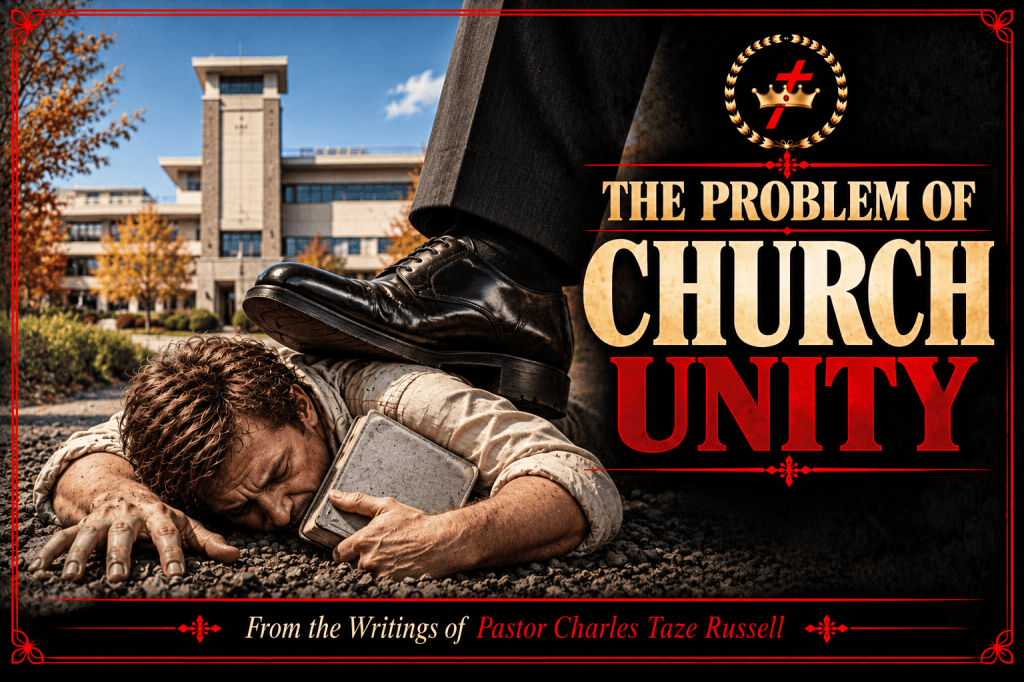
In 1897, Pastor Charles Taze Russell addressed a related question in his article “The Problem of Church Unity.” Responding to proposals for ecclesiastical federation, Russell defended the Christian’s individual responsibility to Christ and warned against the dangers of human religious authority.
His words are particularly striking:
“The object of Satan, and unwittingly of those whom he deceives, has ever been to deprive the individual Christian of the liberty wherewith Christ has made him free, and under one pretext or another to sink the individual in the mass, under human heads and authorities.”
For Russell, Christian liberty was not the enemy of true unity. Rather, submission to Christ—not submission to a human religious authority—was the essential foundation of Christian fellowship.
The following article, originally published in Zion’s Watch Tower, March 1, 1897 (R2114), presents Russell’s argument in his own words.
THE PROBLEM OF CHURCH UNITY.
Under this caption the Christian Statesman says:–
“What we maintain is no mere speculative theory, away up in the ecclesiastical clouds, and impossible of realization in this matter-of-fact world. On the contrary, it is the simple, practical, Scriptural rule by which the Church of Christ, according to her divinely ordained nature, is under obligation to order her earthly life….We believe that the church cannot effectively meet concentrating hostility in her present divided condition, with her separate denominations often failing to cooperate and not infrequently working at cross purposes. We further believe that she will be compelled in the near future to search for the true solution of the problem of her imperatively needed organic unity. We are constrained, therefore, to point out what we are fully convinced is the remedy that must soon be applied for the healing of her sectarian divisions….The church, like the state, is a social being made up of individual members. Each of these collective beings, by divine ordainment, is clothed with authority in its appropriate sphere of action. And in each of these collective or social beings are found subjects of authority. Christ is the Sovereign Lord and King over both church and state. His Word, given in the sacred Scriptures, contains supreme law for each of these social bodies in its distinct sphere.
“Due regard in the state for the law of Christ secures for it the balance of political authority and the liberties of the citizen, and thus the establishment and preservation of national organic unity. And in like manner due respect for the law of Christ will secure to the church and all her individual members the balance of ecclesiastical liberty and law and consequent enduring organic unity. The admitted differences between the sphere and functions of the church on the one hand and the sphere and functions of the state on the other hand will not affect this analogy. Ecclesiastical authority wields no material sword. Its penalties are spiritual.”
It is seldom that we find the advocates of Church Federation so outspoken as this; but we admire honesty and frankness even in a bad cause;–and as our readers well know we esteem the movement for the proposed organic union of the churches and then their cooperative union with the state a very bad cause;–one fraught with danger to the liberties of all classes–but foretold in the Scriptures as associated with the great trouble with which the social and ecclesiastical order of this Gospel age will come to an abrupt end.
We deny every proposition of the quotation.
(1) We deny that the church (collectively) is “clothed with authority.” On the contrary, we hold that the individual Christian is free from authority except that of the head of the true Church–Christ. His fellows may advise with him or may withdraw from his fellowship, but they have no “authority” over him according to the Scriptures. Since there are none “clothed with authority,” there can be no “subjects of authority.” The object of Satan, and unwittingly of those whom he deceives, has ever been to deprive the individual Christian of the liberty wherewith Christ has made him free, and under one pretext or another to sink the individual in the mass, under human heads and authorities. Papacy is a woeful illustration of Satan’s successes in this direction in the early centuries of this age; and the Protestantism of the sixteenth century, which never entirely rid itself of that influence, is now being drawn into the same snare.
(2) It is not true, as stated, that God’s Word given in “the sacred Scriptures contains supreme law for each of these bodies.” On the contrary, the Lord’s commands and counsels and promises were first to the little nation of Israel only, and secondly to the peculiar people, royal priesthood and holy nation–the Church called out of the world and begotten of a new spirit through that Word. And the Lord’s words to the Church are not as an organization but as individuals only. “If any man [individually] will be my disciple, let him deny himself, and take up his cross, and follow me. He that hath an ear let him [individually] hear.” So far from recognizing the state, the nations, and giving them laws, the Lord’s Word declares that they are all “kingdoms of this world” and under “the Prince of this world”–Satan. And through the prophet he has pictured these Gentile governments or states as ferocious beasts, and told of their utter destruction at the time of the establishment of his Kingdom for which he taught us to pray, “Thy Kingdom come!”
(3) It is not true that “Due regard in the state for the law of Christ secures for it the balance of political authority.” Quite to the contrary, the balance in politics often goes to the side of the corrupt and the saloon element. The history of the various so-called Christian States of Europe, written in blood, shows that none of them have ever been controlled by the laws of Christ, but all of them per force on contrary lines. Christ gave no national laws because his kingdom is not of this world. He rules individually each citizen of his heavenly kingdom.
(4) The claim that such an organized and dominating Ecclesiastical Authority would need no sword but would merely execute spiritual penalties is delusive. This was Papacy’s claim in the zenith of her power. For instance, she damned the Huguenots as “heretics,” told how God would torment them in the future, and declared that “heretics” had no rights which governments or people were bound to respect, and promised eternal rewards to all who would oppose them. And when the French king, thus incited, entrapped and massacred them Papacy struck medals to his honor and made him a saint. Thus spiritual penalties and rewards was interpreted not very long ago. We do not presume that Protestant authority would at once become so arrogant, but in some form all dissenters would be considered “heretics” or “anarchists,” and persecuted to the extent that public sentiment would sanction.


Leave a Reply